
The Founding: A Church for German Catholics
Bishop Joseph Rosati
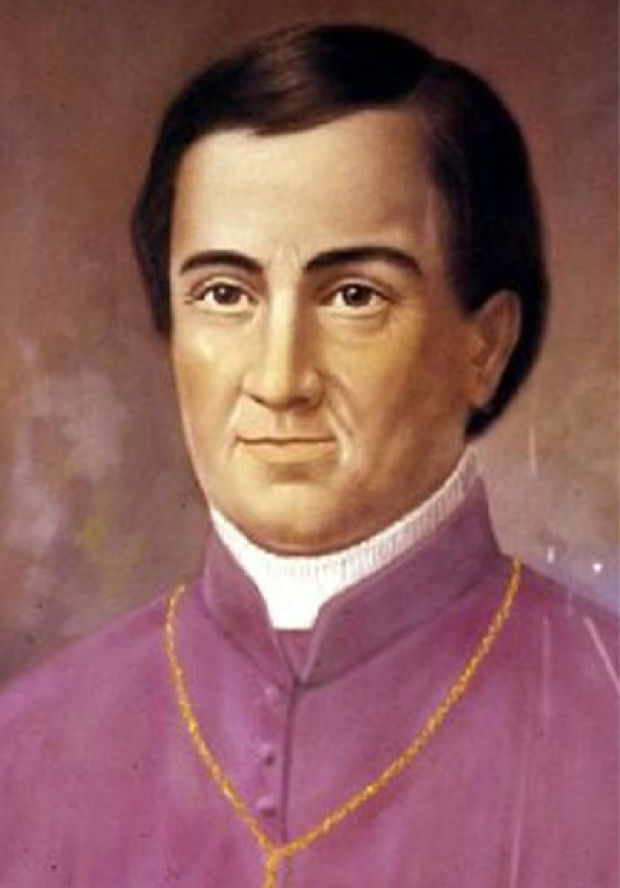
The arrival of increasing numbers of German Catholic immigrants in St. Louis created urgent demand for a church of their own. Bishop Joseph Rosati had purchased land for a German church by 1839 — which he planned to call “St. Mary for the Germans” — but died in 1843 without raising sufficient funds to build it, the same year European reports accused American bishops of neglecting German Catholics.
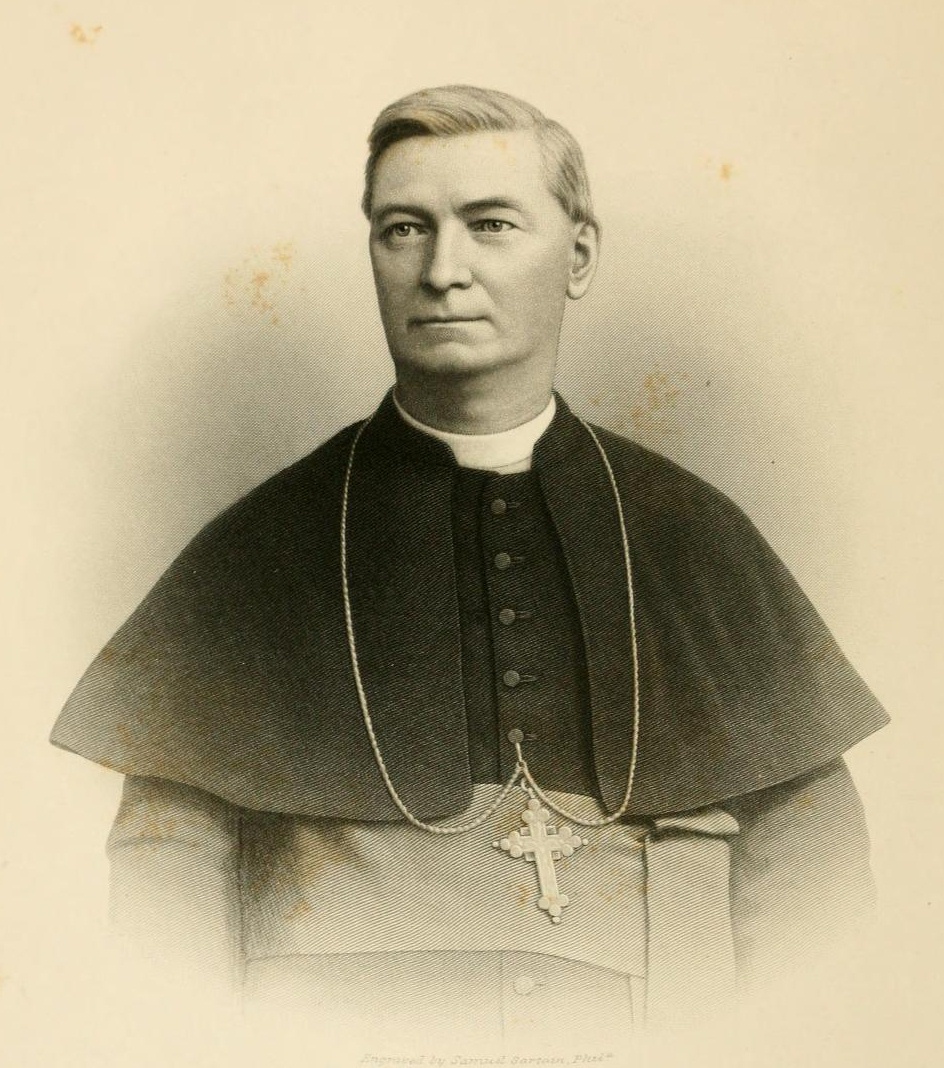
His successor, Bishop Peter Richard Kenrick, responded swiftly. He accepted a donated parcel from Ann Lucas Hunt, better situated within the German settlement, then purchased the remaining half of the proposed site from her brother for $2,500.
Archbishop Peter Richard Kenrick
The cornerstone was laid June 25, 1843, but construction stalled almost immediately — the diocese carried heavy debt from Rosati’s earlier building projects. Late in 1843 Kenrick petitioned the Leopoldine Society of Vienna for aid, writing:
“I take the liberty of informing your grace concerning the needs of the German Catholics of the Diocese of St. Louis and especially of this city, the number of which has now risen to 6,000. No serious attempt has so far been made to provide a church, exclusively for the use of the German Catholics, but they have been obliged until now, to attend divine service in the church which belongs to the French and American Catholics… I am constrained to suspend work on the building, which is so near completion. The German Catholics, for the most part, belong to the working classes, and feel all too keenly the pressure of hard times.”
The Leopoldine Society responded generously. Combined with Kenrick’s personal gift of $1,000 and local offerings, the church — completed with nave only — was dedicated on September 15, 1844, at a total cost of $8,000.
The architect was Franz Saler, an Austrian-born parishioner who appears in the 1843 City Directory as a bricklayer and mason. He also built St. Patrick’s (1845) and St. Vincent de Paul’s (1845), and was a founding member of the St. Vincent de Paul Society in St. Louis.
The Succursal Struggle
Despite the victory of building the church, Bishop Kenrick’s pastoral letter of May 25, 1845 established St. Mary’s as a succursal (subsidiary) parish, denying it full diocesan juridical rights — a status that would generate bitter conflict for decades. The church served the five hundred German families within the Cathedral parish boundaries, preserving their language and customs, but without equal standing before Church law.
The First Rectors
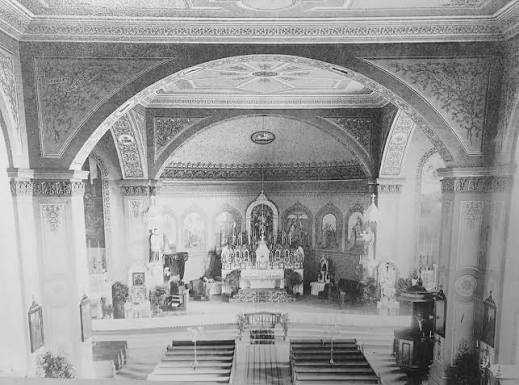
The first rector, Rev. John P. Fischer (1844–1847), purchased an old log house across the street for a combined priests’ residence and school — laying the foundation for ethnic education that German Catholics valued deeply. Father Fischer planned the interior wall paintings, hiring St. Louis decorator Paul Hoegen to execute them, and purchased the stained glass windows praised for their artistry in an 1844 Cincinnati German newspaper.
Also stationed at St. Mary’s in these early years was Rev. Ambrose J. Heim, who organized the first conference of the St. Vincent de Paul Society in North America and devised an immigrant banking system so successful that Archbishop Kenrick adopted it diocese-wide as the “Archbishop’s Bank,” appointing Heim archdiocesan secretary in 1847.
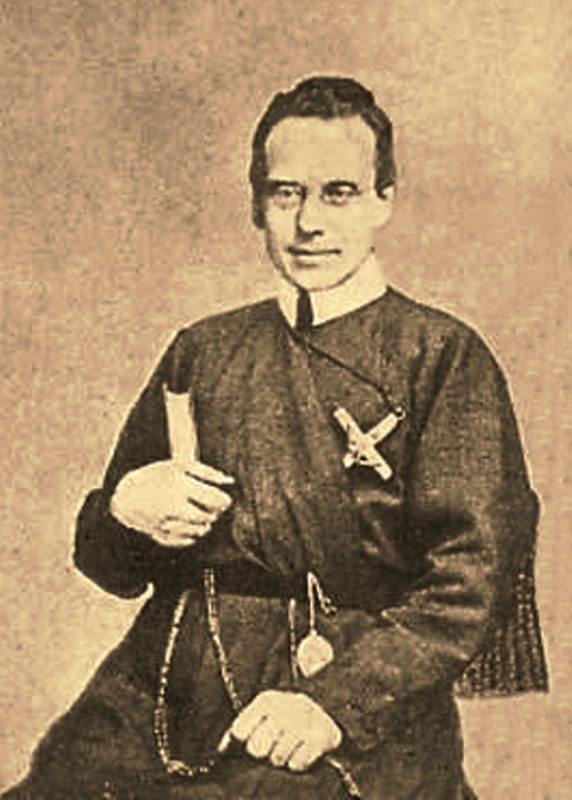
Blessed Francis Xavier Seelos at St. Mary of Victories
It was in St. Mary of Victories that Blessed Francis Xavier Seelos, C.Ss.R., made his Missouri preaching debut. Together with Redemptorist companions Fathers Schneider, Jacob, and Gulielm, Seelos preached a parish mission in German from October 1 to 15, 1865 — shortly after the Civil War.
Born in Füssen, Bavaria in 1819, Seelos came to America in 1843 and was ordained in Baltimore. He worked alongside St. John Neumann in Pittsburgh before becoming an itinerant missionary preaching across nine states in both English and German. He had earlier met personally with President Abraham Lincoln to plead for seminarians to be exempted from Civil War conscription.
Pope Pius IX offered him the Bishopric of Pittsburgh — Seelos humbly declined, asking instead to remain with the people as a preacher. His cheerful spirit, simple manner, and extraordinary gift as a confessor made him beloved wherever he went.
After his mission here, Seelos was assigned to New Orleans in 1866. Exhausted from caring for yellow fever victims, he contracted the disease and died on October 4, 1867, aged 48 — the feast of St. Francis of Assisi, whose name he bore.
Pope John Paul II beatified him on April 9, 2000.
St. Mary of Victories is honored to house a first-class relic of Blessed Seelos, as well as one of only five known death masks of the holy priest. A side altar in the nave is dedicated to his honor, built from the communion rail of the demolished St. Malachy’s Church.
Rev. Joseph Melcher (1847–1868)
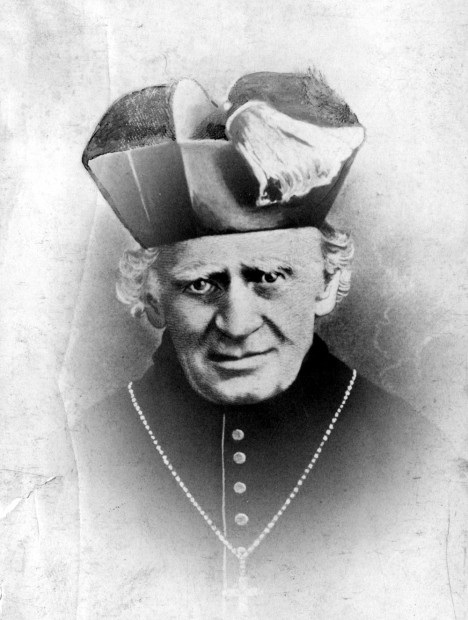
Rev. Joseph Melcher
The second pastor, Rev. Joseph Melcher of Vienna, had served twelve years as chaplain to the Court of Modena before his missionary assignment to St. Louis. Kenrick chose him as his theologian at the Sixth Provincial Council of Baltimore in 1847, then appointed him Vicar-General for the St. Louis Germans and sent him on three recruiting trips to Europe (1847–1864) to find German-speaking priests.
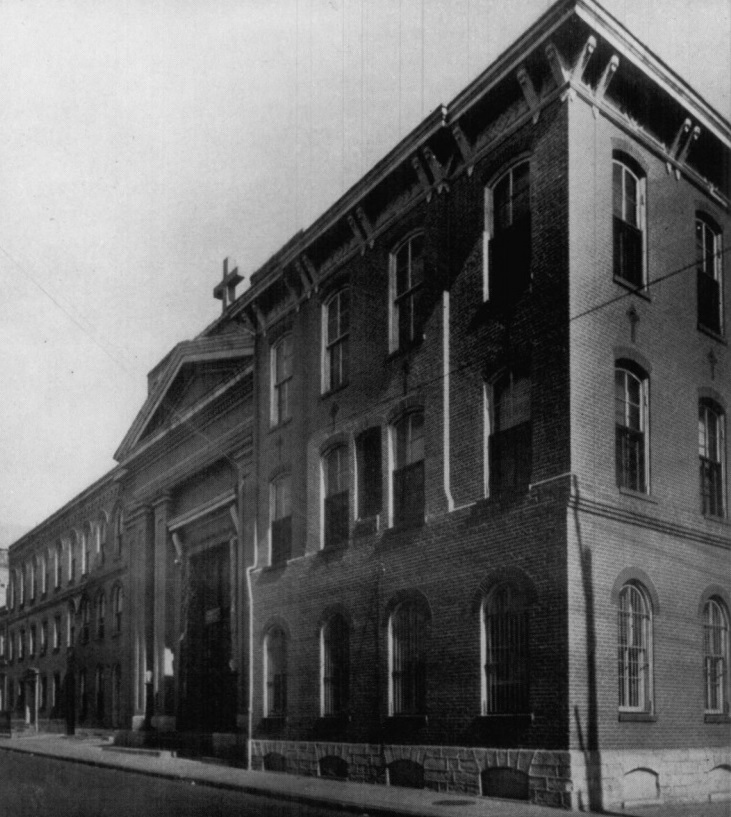
Melcher brought future pastors Henry Muehlsiepen and William Faerber from Germany, along with the Ursuline nuns who first taught at St. Mary’s school. In 1850 he founded the St. Vincent’s German Orphan Society to care for children orphaned in the 1849 cholera epidemic. A new brick school was built in 1856, and in 1860 a transept and belfry were added, bringing the total building cost to $13,000.
It was in October 1865 that Blessed Francis Xavier Seelos, C.Ss.R., itinerant Redemptorist preacher, came with other priests to give a parish mission at St. Mary’s. Father Melcher’s own extraordinary career culminated on July 12, 1868, when Archbishop Kenrick consecrated him the first Bishop of Green Bay, Wisconsin — in St. Mary of Victories Church itself.
Father Muehlsiepen & the Franciscan Sisters of Saint Mary (1868–1870)
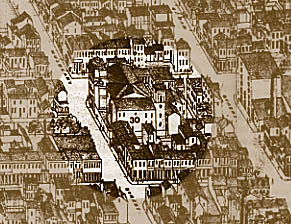
St. Mary’s block, 1874
Henry Muehlsiepen, popular assistant rector for ten years, was appointed pastor in 1868. Called the “apostle of the Germans in Missouri,” he founded the Catholic newspaper Pastoral Blatt and established a clergy association before his responsibilities as Vicar-General for German, Polish, and Bohemian parishes forced his resignation from St. Mary’s in 1870. In 1872, the Franciscan Sisters of the Sacred Heart, having emigrated from Germany, came to St. Louis and took a new name from St. Mary of Victories, becoming the Franciscan Sisters of Saint Mary. They would go on to found SSM Health Care, which today serves millions across the Midwest. We are honored to have an example of their original habit on display in Mindszenty Hall.
Rev. William Faerber & the German-American Struggle (1870–1905)
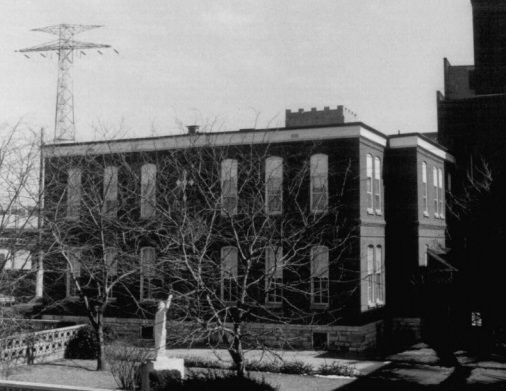
The parish school building
The long pastorate of Rev. William Faerber (1870–1905) was a defining chapter in German-American Catholic history. An “excellent writer and man of broad cultural interests,” Faerber became editor of Pastoral Blatt in 1873 and a leading national voice for German-American parish rights.
When Archbishop Kenrick’s 1842 letter establishing English-speaking parishes as superior was republished in the early 1880s, lines of battle were drawn. Father Faerber replied to critics who called German ethnic consciousness a “canker eating away the life of the Church”:
“As a rule, the German in this country soon makes himself at home, and becomes as good an American citizen as those of any other nationality… Forcible, premature interference is always dangerous. It would be dangerous and foolish to wish, at present, forcibly to solve these delicate questions by suppressing, slighting, or disfranchising the people of any nationality.”
When 82 St. Louis priests petitioned Rome in 1884 at the Third Plenary Council of Baltimore, Faerber supported them from Rome. The battle continued through the Abbelen Memorial (1886) and the Lucerne Memorial (1891), which drew accusations from Archbishop Ireland of St. Paul that St. Louis was “the clique of foreign-minded and short-sighted Catholics.”
Resolution & Decline
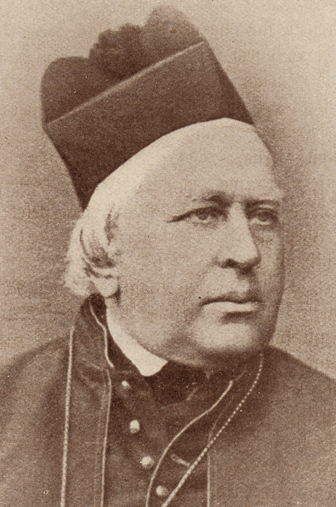
Archbishop John Joseph Kain
The succursal status battle was finally resolved by Archbishop John Joseph Kain in the Third Synod of St. Louis, 1896, declaring foreign-speaking parishes equal to English ones “in as far as parochial rights and privileges are concerned.” But by then, German immigration had declined and later generations had moved to better neighborhoods. After Father Garthoeffner’s death in 1917 (he founded the first Archdiocesan high schools), the parish diversified to include Syrian families and others.
The parish’s decline accelerated sharply in 1939 when the National Park Service began demolishing buildings within parish boundaries for the Jefferson National Expansion Memorial. An extensive interior and exterior restoration was nonetheless completed in time for the church’s Centennial in 1943. Then, scarcely a decade later, the Third Street Interregional Highway (now Interstate 55) cut within yards of the church’s doorsteps.
A Hungarian Home (1957–Present)
New life came to St. Mary’s in 1956 when the church was entrusted to a Hungarian congregation that had previously worshipped at St. Stephen’s Church, 12th and Chouteau Streets. Though entirely self-supporting and unable to maintain the full complex (all buildings except the church and school were eventually razed), the Hungarians invested deeply — new roofs on church and school, a new church floor, and conversion of the school to a parish hall.
Cardinal Mindszenty’s visit to St. Louis in 1974 brought powerful encouragement to the community and inspired the founding of a small school named in his honor to teach Hungarian language and culture (now closed). The German heritage of St. Mary’s remains a proud foundation as the parish continues to preserve Hungarian faith and culture in the heart of old St. Louis.