
Pope Francis declared Cardinal Mindszenty “Venerable” on February 12, 2019,
recognizing his heroic virtue.
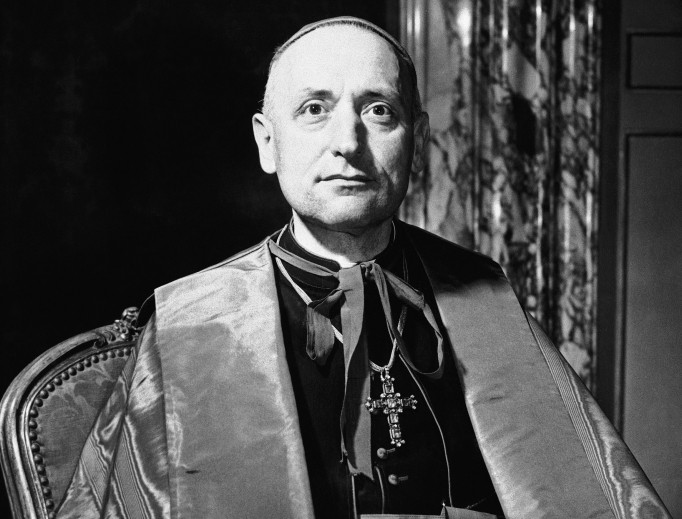
Venerable Cardinal
József Mindszenty
Never Forget
He wrote one sentence before they came for him. Then he vanished for 15 years.
Cardinal József Mindszenty stood at the door of his palace in Esztergom, Hungary. It was December 26, 1948 — the day after Christmas. Secret police cars circled outside. He was the highest-ranking Catholic official in Hungary. A Prince of the Church. And he knew exactly what was about to happen.
Before opening the door, he wrote a note and left it on his desk:
“If you hear that I have confessed or resigned, do not believe it. It will be the result of human frailty.”
Then he put on his plainest bishop’s robe, slipped a picture of Jesus wearing the crown of thorns into his pocket, said goodbye to his elderly mother, and opened the door.
They took him into the night.
Torture and Trial
For 39 days, he was tortured in a basement at 60 Andrássy Street in Budapest — one of the most feared buildings in 20th-century Europe. They beat him, drugged him, starved him, kept him awake until his mind began to collapse. He signed confessions to crimes he had never committed.
On February 3, 1949, he was put on trial. Five days later, sentenced to life in prison. President Truman called it “infamous.” Churchill condemned it. The Pope excommunicated everyone involved. Mindszenty heard none of it. He was in solitary confinement.
The Revolution and the Embassy
Seven years passed. Then, on October 23, 1956, Hungary rose against Soviet occupation. Students marched. Workers joined them. Soldiers defected. On October 30, revolutionaries reached Mindszenty’s prison. He had been locked away for 7 years and 10 months. He gave a radio address praising the uprising. Hungary was going to be free.
It lasted three days.
On November 4, 1956, Soviet tanks entered Budapest. They killed 2,500 people and forced 200,000 to flee. Mindszenty ran to the U.S. Embassy and asked for asylum. The Americans said yes. He walked through the doors on November 4, 1956.
He would not walk out for 15 years.
His room was a converted office — no windows that opened, a bed, an altar, a corner for prayer. He could not step into the courtyard. Could not be seen from the street. Outside every day, a secret police car waited with three plainclothes officers watching the door.
He said Mass each morning. Wrote his memoirs in secret. Walked the same corridors again and again. Years passed. 1960. 1965. 1970. He was still there.
Exile and Death
In 1971, the Pope ordered him to leave — to come to Rome, to step aside. Mindszenty wrote back: “I accept what will be perhaps the heaviest cross of my life.”
On September 28, 1971, after 5,475 days, he walked out of the embassy. He wore a black fedora. As the car crossed into Austria, he removed the hat. Beneath it was his red cardinal’s zuchetto. He wanted Hungary to see who was leaving. He never returned.
In 1974, the Vatican removed his titles. He had not resigned. He published his memoirs. Six months later, he died in Vienna on May 6, 1975. He was 83. He had asked that his body not be returned to Hungary “until the last Soviet soldier has left.”
The Soviets left Hungary in 1991. That same year, Mindszenty’s body was exhumed, flown home, and buried in the basilica at Esztergom — the place where he had once been Archbishop. He outlived the regime.
Bishop Fulton Sheen called him the “Dry Martyr” — not killed, but slowly crushed by isolation, torture, and betrayal. Communism tried to break him. He outlasted it. His own Church tried to sideline him. He outlasted that too.
Cardinal József Mindszenty. He fought Nazis. Fought communists. Was tortured. Imprisoned. Trapped. Exiled. Stripped by his own Pope. He died without seeing home again. But he won. Because tyranny collapses — and truth does not.
His Visit to Saint Mary of Victories — June 1974
Cardinal Mindszenty visited Saint Mary of Victories and celebrated Mass here in June 1974 — a visit that made national news. The Cardinal-Archbishop of Budapest-Esztergom participated in a special Mass, seminar, and dinner co-sponsored by the parish and the Cardinal Mindszenty Foundation. His visit brought powerful words of encouragement to the Hungarian community and inspired the founding of a small school named in his honor to teach Hungarian language and culture.
His visit is commemorated with a carved white marble plaque in the sanctuary of Saint Mary of Victories. The parish hall — where he addressed the congregation — has been named Mindszenty Hall in his honor.
Relics and Memorials at SMV: The church holds a carved white marble plaque marking the Cardinal’s visit. Photographs from the 1974 visit hang in Mindszenty Hall. The Annual Homecoming Picnic is held in Mindszenty Hall each August during the Feast of Saint Stephen of Hungary.
Our Partnership with the Cardinal Mindszenty Foundation
Since 2019, Saint Mary of Victories has partnered with the Cardinal Mindszenty Foundation to host a distinguished speaker series on the history of communism, religious freedom, and the Cardinal’s legacy. The Foundation was co-founded in Saint Louis in 1958 by Eleanor Schlafly, her brother Fred Schlafly, his wife Phyllis Schlafly, and Rev. C. Stephen Dunker, C.M., a missionary priest expelled from China by the Communists. Eleanor Schlafly led the Foundation from its founding until 2012, when Liza Forshaw took the helm. Mrs. Forshaw was honored for her service with a Gold Cross of Merit from the nation of Hungary on April 12, 2023.
These events bring scholars, clergy, and public figures to Mindszenty Hall at Saint Mary of Victories for lectures, panels, and discussions that keep the Cardinal’s memory and mission alive for new generations.
Intercession
Venerable József Cardinal Mindszenty, Pray for Us!